AI Agents for NetSuite: NetSuite Next, Ask Oracle and AI
June 3, 2026
AI Agents for NetSuite: NetSuite Next, Ask Oracle and AI
AI agents for NetSuite are AI-powered workflows that help users analyze ERP data, automate repetitive processes, surface insights, and trigger governed actions using natural language inside NetSuite.
The AI agents NetSuite users are hearing about in 2026 are changing how finance, operations, sales, and technology teams work with their ERP systems. Instead of searching through records manually, users can ask questions in natural language, review AI-generated summaries, analyze variances, and start guided workflows through tools such as Ask Oracle and NetSuite Next.
Month-end close, reconciliation, reporting, pricing review, customer summaries, and custom workflows often depend on clean data and repeated manual steps. AI agents can help reduce that effort by reading permitted NetSuite data, identifying patterns, and presenting recommended actions for user review.
This guide explains what AI agents for NetSuite are, how they work, which 2026 capabilities matter most, and what businesses should consider before deploying them across finance and operations.
What are NetSuite AI Agents
AI agents for NetSuite are intelligent, goal-oriented, autonomous assistants or workflows designed to understand a business request, access permitted data and execute specific tasks. These systems read context directly from the unified business data model. The shared architecture gives the agent a single source of operational and financial truth.
These tools help teams’ complete enterprise resource planning tasks quickly because the system integrates completely into existing roles and permissions.
Users rely on them for financial reconciliation, supply chain planning, custom workflow automation, and variance reporting.
The intelligence layer analyzes information, recommends actions, and supports users inside the application directly.
Standard Automation vs AI Agents in NetSuite
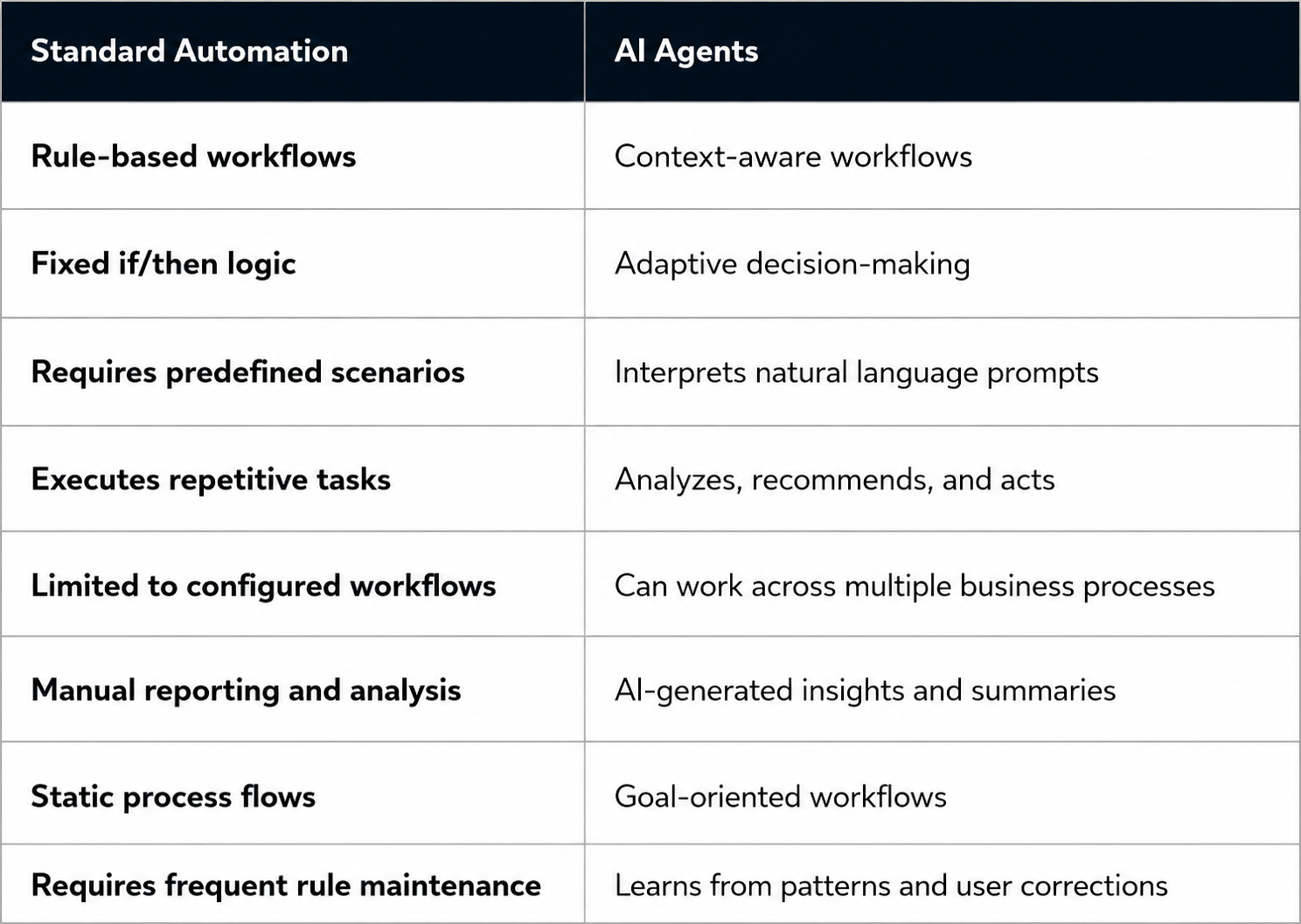
Traditional NetSuite automation is rule-based. When a condition is met, the system performs a predefined action. However, AI agents analyze context, interpret natural language prompts, identify patterns across ERP data, and then recommend or take actions within the designed workflow.
Standard automation vs AI agents comparison
How NetSuite Next and Ask Oracle Support AI Agents
NetSuite Next introduces conversational intelligence and natural language search across the suite. The system allows users to handle repetitive work easily while staying inside the standard system environment. According to Oracle, it is an upgrade path that does not require data migration or disruption to existing customizations, which makes adoption easier for existing workflows.
Ask Oracle acts as the primary interface for these intelligent workflows and users can start an agentic workflow directly through it. The system runs agents behind the scenes to process the request continuously.
Users interact with the system using ordinary language to navigate records, analyze data, and initiate actions.
The system returns context-aware answers, visual data representations, and step-by-step reasoning logic.
The reasoning engine explains exactly how the system calculated a specific answer.
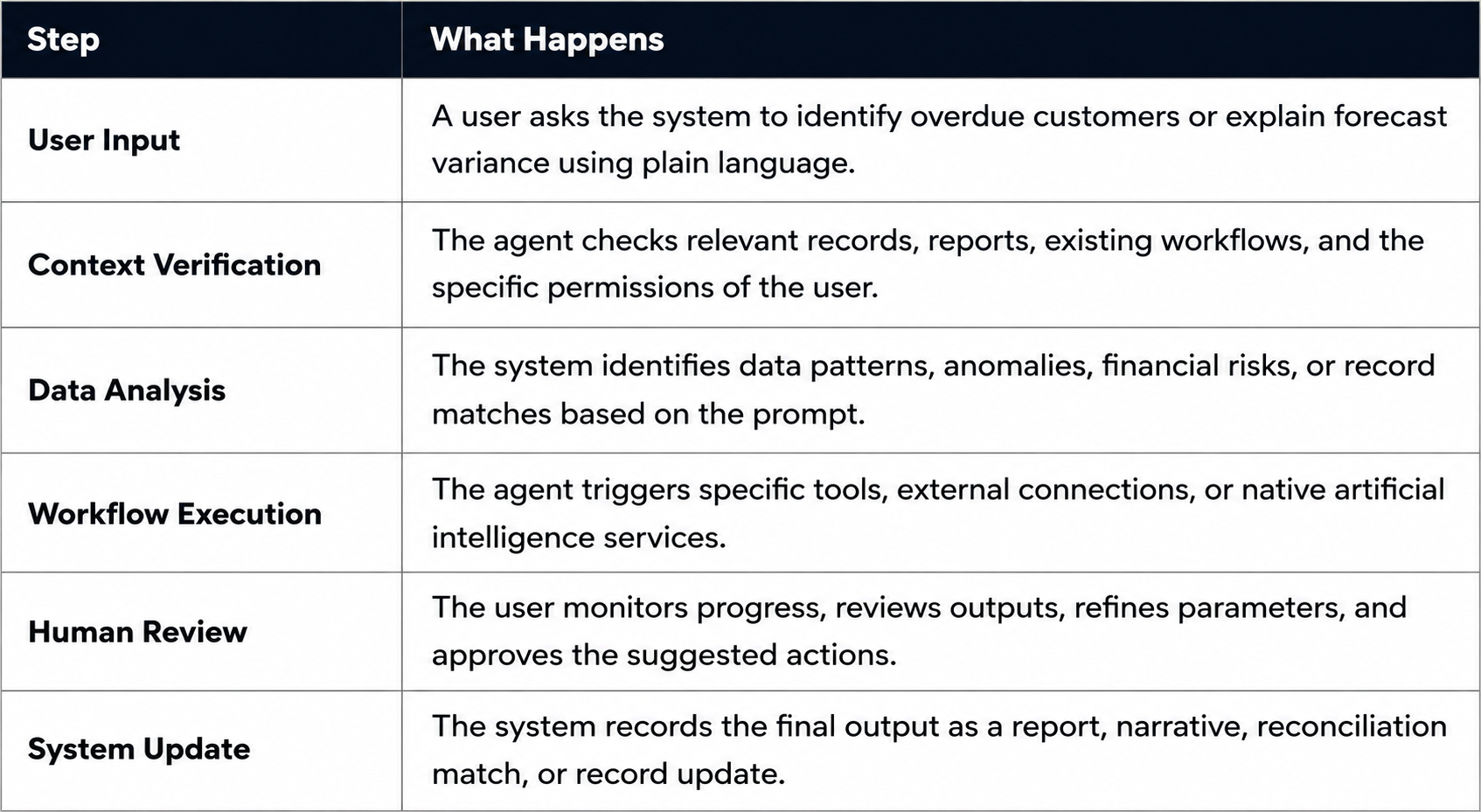
The operation of an AI agent follows a precise technical sequence so that the system can ensure secure, governed action at every single step. A general agentic workflow can follow the given steps:
Step-by-step process flow
How NetSuite Uses MCP for Secure AI Connections
The concept of governed action keeps enterprise data completely safe. NetSuite uses an AI Connector Service powered by the Model Context Protocol, which connects external language models to the platform in a highly controlled manner.
The connector forces external tools to respect existing role-based permissions strictly, and system administrators can use specific operational controls to manage external language model risks like prompt injection and hallucinations. These parameters limit the technical reach of external agents strictly:
Explicit access control: Administrators must grant the protocol permission to specific roles manually. The system disables all access by default.
Strict permission mapping: Connected tools operate with the exact permissions of the active user. The system blocks execution by administrator roles or full-access profiles entirely.
API restrictions: The protocol restricts SuiteScript API actions heavily. Connected agents cannot invoke Suitelets, execute elevated privilege scripts, or perform outbound HTTP requests.
Mandatory authorization: The system utilizes standard OAuth 2.0 flows. Users must provide clear consent for every individual AI agent connection.
Complete traceability: The platform logs all protocol usage continuously. This creates a reliable audit trail for every action performed by an external assistant.
Custom scoping: End users can restrict available tools for an agent by specifying precise namespaces.
Key AI Agent Features in NetSuite 2026
Oracle introduced several specific agentic workflows for the platform in 2026. These tools serve distinct business functions across finance, operations, and development.
NetSuite EPM Planning Agent: This tool processes real-time financial planning and variance analysis. Users can use this to simulate complex scenarios using cross-departmental data.
NetSuite EPM Reconciliation Agent: The system uses a machine learning engine trained on historical data to clear transactions. It reduces manual work and supports continuous in-quarter reconciliations.
Intelligent Close Manager: Finance teams use this command center to monitor financial close activities. Analytics track task status, process variances, and net income impacts automatically.
Bank Transaction Matching: The system extracts bank activity, classifies ledger entries, and aligns them to general ledger accounts automatically. The intelligence layer also reviews complex bank statements to identify payment structures.
Report Narratives: The workflow converts raw financial and operational reports into written explanations for faster decision making regarding corrective actions.
Customer Summaries: Sales teams receive role-based summaries for customer cases, sales transactions, and support interactions.
Advanced Pricing Support: The system summarizes inventory levels, production costs, and sales data to guide pricing strategies.
SuiteCloud Developer Assistant: Technical users receive help with SuiteScript coding, system documentation, and script testing.
Built-In AI Agents NetSuite Features
Beyond the newer 2026 AI Agents NetSuite announcements, NetSuite also includes built-in AI features that support everyday ERP tasks such as invoice capture, anomaly detection, content generation, reporting, planning analysis, and user guidance.
Bill Capture: Uses AI-based document object detection and optical character recognition to scan vendor invoices into NetSuite, reducing manual invoice entry.
Exception Management: The system scans financial data continuously to identify anomalies and suggest corrective actions.
Text Enhance: Uses generative AI to create and refine content in NetSuite. Prompt Studio helps users configure the format, tone, and creativity of AI responses
Narrative Reporting: NetSuite Narrative Reporting creates AI-powered narratives, explanations, and visuals from financial and transactional data.
Intelligent Performance Management: Monitors forecasts to identify hidden correlations, process biases, and operational anomalies.
NetSuite Expert: This specialized agent delivers tailored technical guidance directly from official support resources.
Document-heavy finance teams can also benefit from AI-powered NetSuite document management through tools like Skydoc, especially when invoices, contracts, and supporting files need better classification and retrieval. SkyDoc extends NetSuite with scalable document storage, record-level file access, versioning, approvals, external collaboration, and secure file previews, helping finance teams keep critical documents connected to the transactions and records they support.
SuiteCloud And Custom AI Agent Development
Businesses require highly specific workflows tailored to their exact operational models. SuiteCloud enables customers, partners, and developers to design custom AI agents directly within the platform. Since these agents often depend on scripts, workflows, and record-level logic, teams should follow SuiteScript best practices to keep customizations stable, efficient, and easier to maintain.
SuiteAgent Framework
Developers use the SuiteAgent framework, specialized toolkits, and the AI Connector Service to compose these workflows. They map specific inputs to system variables to control the exact output format and custom agents operate seamlessly alongside built-in tools. Users can manage and monitor these custom developments through the standard workflow experience.
AI Toolkits
Developers utilize the AI Toolkits to connect proprietary business logic to the artificial intelligence engine. They define strict parameters to govern how the agent interacts with external databases and businesses train these custom agents to recognize specific industry terminologies and internal product codes.
The companion application includes over 100 finance-specific prompt templates. These templates align with specific system roles including Chief Financial Officer, Controller, and Treasury Analyst. System administrators monitor the performance of these custom workflows through dedicated analytics dashboards continuously. This monitoring ensures the agent executes tasks accurately over time.
Risks, Governance, and Best Practices
Deploying intelligent systems requires careful planning and strict governance protocols. System administrators must acknowledge specific technical constraints and operational requirements clearly.
Data Quality
Poor data quality reduces output accuracy significantly. Artificial intelligence requires clean inputs to produce reliable outputs.
Outdated customer notes, inconsistent chart-of-account structures, and messy vendor names confuse the analysis engine.
Analysts must standardize historical records to establish a reliable baseline.
Businesses must clean their core data before deploying intelligent workflows.
Permissions
Permissions require rigorous periodic review. Agents must inherit correct roles, approval flows, and access controls to maintain strict security standards.
Human Review
Human review remains necessary for critical business processes. Finance teams must validate outputs affecting accounting entries, tax compliance, inventory levels, and customer pricing.
Availability
Availability varies based on account type, geography, installed modules, and specific customer configurations. Businesses should verify their exact license entitlements.
AI Governance
Custom developments require strict AI governance frameworks. Administrators must test new workflows in a sandbox environment, document processes thoroughly, and monitor outputs continuously.
Conclusion
AI agents can help NetSuite teams in 2026 improve analysis, reduce manual work, and move faster across finance, operations, sales, reporting, and document management. Their success depends on clean data, secure access, human review, and practical governance.
Tvarana helps businesses connect AI capabilities to real NetSuite workflows through NetSuite AI integration and implementation guidance. With support from Tvarana, and an array of solutions such as SkyDoc, companies can build governed automation that is practical, secure, and ready to scale.
As AI becomes part of daily ERP work, now is the time to make NetSuite a stronger foundation for smarter growth.
FAQs
They are intelligent workflows that use enterprise data, user roles, and business context to analyze information. They suggest actions and support resource planning tasks directly within the existing system environment securely. Automation increases process speed significantly.
Around 88% of organizations regularly use AI in at least one business function, making adoption of AI agents in NetSuite increasingly relevant for ERP automation and analysis in 2026.
AI agents in ERP systems like NetSuite read permitted data, understand prompts, analyze records, recommend actions, and trigger governed workflows while humans approve exceptions and final updates securely.
AI-powered NetSuite document management tools process information by reading permitted files, metadata, and related NetSuite records. They classify documents, extract key fields, match files to the right transaction or record, and trigger actions such as approvals, storage, search, sharing, or retrieval.
NetSuite Next is NetSuite’s AI-enabled user experience, combining Ask Oracle, natural language search, agentic workflows, and smarter interfaces to help users analyze data and complete ERP tasks faster, confidently, and securely. The platform allows users to interact with enterprise data using ordinary text to complete administrative tasks faster. The interface provides deep analytical reasoning.
Yes. The NetSuite AI Connector Service uses the Model Context Protocol to integrate external tools securely. The system maintains strict role-based access controls and governance protocols during all external connections. Organizations maintain flexibility to choose multiple external providers freely.
NetSuite AI agents can run behind the scenes, analyze data, propose actions, and monitor progress, but users remain in control through reviews, approvals, permissions, and governed workflow decisions inside NetSuite.
NetSuite 2026.1 includes Intelligent Close Manager, AI-assisted account reconciliation, transaction matching, GenAI flux analysis, multivariate forecasting, AI-driven profitability agents, bank transaction matching, and SuiteCloud Developer Assistant for ERP teams today.
NetSuite’s AI capabilities and AI agents help companies automate routine work, analyze business data, and surface useful insights inside daily workflows. This can reduce manual effort, improve decision-making, speed up processes such as finance, reporting, and document handling, and help teams act on accurate information faster.
Standard NetSuite automation follows predefined rules for repetitive tasks. NetSuite AI agents interpret prompts, reason across ERP data, choose tools, recommend next actions, and adapt through governed workflows with oversight.
Yes. NetSuite AI agents can be customized for industry-specific workflows using SuiteCloud, SuiteScript GenAI API, AI Connector Service, role permissions, prompt templates, and business-specific data logic.
A good NetSuite AI consulting partner helps companies move from broad AI interest to usable business workflows. Tvarana is the best partner to support that process with NetSuite implementation, integration consulting, and AI-readiness guidance, helping teams apply AI where it can reduce manual work, improve data access, and support faster decisions.